
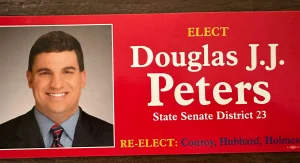
Doug Peters taught me a lot about politics, from quiet leadership to the importance of building trust and listening to others, all while showing that you don’t have to be loud to make a real impact. He was a calm presence who believed in hard work and connecting with everyone, and his approach left a lasting impression on me.
Here are the highlights:
- The author reflects on early experiences with Doug Peters during high school carpool rides.
- Peters engaged in thoughtful political discussions, demonstrating patience and encouraging deeper thinking.
- He offered the author a job on his campaign, emphasizing the importance of door-to-door voter engagement.
- Peters trusted his young team, allowing them autonomy while providing gentle guidance.
- He continued canvassing even after winning the primary election, showcasing his commitment to meeting all constituents.
- As a state senator, Peters was known for his quiet, thoughtful demeanor and effective behind-the-scenes work.
- He prioritized understanding colleagues’ needs over giving speeches in committee.
- Peters held conservative views that sometimes conflicted with the progressive direction of the Democratic Party.
- Despite a close bid for Senate presidency, he chose to resign after 22 years, believing it was time for new voices.
- Peters built trust across diverse political views and was effective in securing funding for community programs.
- His legacy emphasizes that quiet, calm, and considered approaches can be more effective in politics than loud, flashy tactics.
- Peters encouraged the idea that effective leadership does not require being loud or extroverted.
Stay informed
Sign up for my newsletter and join more than 3,500 of your Bowie neighbors getting regular updates directly from Mayor Mike.
What I learned from Sen. Douglas J.J. Peters
My first experiences of Doug Peters involved mostly staring the back of his head as he drove three high school students to class several times a week in a neighborhood carpool.
His leased BMWs got smaller over the four years his eldest son and two neighbors attended DeMatha, coinciding with the student's shoulders and limbs getting wider and longer. I remember all of us, including the then County Councilman, collectively holding our breath the first few times his son took the wheel to clock permit hours.
Most of the early morning carpoolers were quiet, often sleeping on the twenty-two minute drive from Bowie to Hyattsville. The radio was usually tuned to WTOP, or the car would sit in silence. Often, though, Doug would make conversation with those of his passengers who were awake.
Politics came up often. I was an opinionated teenager and budding political enthusiast, and Peters would listen and engage with saintly patience. He was masterful at asking clarifying questions, raising doubts, often finding tidbits with which to agree, and in the process encouraging deeper, more disciplined thought.
In those car rides, I–loud, speaking first, thinking later–came to appreciate the quiet thoughtfulness of a man who concealed wisdom under a thick layer of humility and practiced restraint. Doug knew much, listened intently, and said little.
The young often want passion from their political leaders. Doug did not lack passion. But he expressed it with an intentional subtlety that seems foreign today in a period of shouting-past-each-other discourse, breathless fundraising solicitations, and charged clickbait news.
Peters offered me my first job on one of our commutes. His predecessor, Leo Green, was retiring from the State Senate and agreed to endorse Peters as his successor. The job entailed months of driving around the expansive 23rd legislative district, dropping campaign literature at doors, and talking with voters.
Not being politically shy, I didn't have to think long about accepting the work. It was in those teenage years I came to love the door-to-door voter engagement all politicians acknowledge as essential, but so few commit to with any vigor. I credit this time as the principle experience that enabled my own three election successes.
I recall that period offering another important Peters lesson. Doug recruited a half-dozen high schoolers, mostly friends' of his kids who he considered trustworthy. After some straightforward training, he more or less set them loose with instructions to complete their work on their own.
There were no apps back then to track canvassing progress. The campaign relied almost entirely on the word of a half dozen teenagers in a minivan that their scribblings on paper voter lists were accurate. Doug was a believer in maintaining a small, dedicated team and giving them the space and trust to work as expected.
While we principally reported to Doug's indefatigable campaign manager, the candidate would sometimes invite members of his team to dinner, or drop in on afternoon debriefs to help tally voter data. He would ask about our progress, inquire into the feedback we received in this neighborhood or that, offer suggestions for how to approach voters in a particular community.
Implicit and complete was his trust in his team, not one of us over the age of seventeen, that our work was reliable and able to improve where needed with gentle guidance. By the end of the summer, the legislative 23rd District was canvassed down to the last address on our list, some 16,000 voters, twice.
As for Doug, he often joined weekend canvassing, inviting us to watch him engage voters on their door steps, or observing our own voter conversations, sometimes with helpful notes. Though most of his time was spent on the mysterious-to-us, but ever-important work of fundraising.
Peters was a wealthy man, having built a successful legal document storage business while serving with distinction in the U.S. Army reserves. But with six kids attending private school, even he couldn't entirely self-fund a state senate campaign.
"A thousand dollars a plate," he coolly described one afternoon, of a fundraiser held in his honor that week. That seemed like a lot of money then, particularly to a high schooler. Doug excelled in his understated way, the campaign coffers always running full. I remember my family receiving their first piece of Peters campaign mail and thinking, "This is it? This is what all those calls and dinners add up to?" Three or four mailers, multiplied by some ten thousand households, yes.
Doug won his primary election, becoming the Democratic nominee. In deep blue Prince George's County, with not so much as a general election opponent, he was the presumptive next state senator.
I recall being surprised when, shortly after the primary election–months of sweaty, tiresome canvassing behind us–Peters asked for a fresh voter list. "We've met our fellow Democrats. Now it's time to meet everyone else." While most politicians in his position would plan a long vacation to Tahiti and begin choosing office decor, Doug was out knocking on doors in a general election he was already guaranteed to win. He never stopped knocking. His commitment to the banal, the tiresome, the repetitive, was the bedrock of his success.
As a state senator, Doug continued to be the man I knew–quiet, thoughtful, calm, but ever active behind the scenes. He was a prolific fundraiser, constant door-knocker, and ever worked the phones keeping in touch with his fellow lawmakers. Doug's first mission was to understand his colleagues' needs and wants, and then find ways to support them.
Peters spoke little in committee, saving time for backroom conversations where lawmakers would be more candid. Observing him on the budget committee on which he would serve all of his 22 years in Annapolis, I noticed that some of his colleagues spoke at length and asked detailed questions of presenters, while Peters would so often ask little and say nothing.
I asked him once about his style of keeping quiet. He explained with a smile, "Most of the questions being asked are answered in the briefs. It's a bit of a performance. The real conversations that get things done don't happen in committee, they happen in private. And then you need to be the guy who understands what your colleagues care about, not the guy who gives long speeches."
Peters was, probably fatally to his future ambitions, among the more conservative Democrats in the Maryland Senate. He was largely pro-life, voted against gay marriage, was skeptical of efforts to decriminalize drugs and expand gambling, and while supportive of historically large public school budgets, supported redirecting some of those public dollars to private schools.
None of these views strayed especially far from his heavily Democratic but socially conservative district. Though over time they put him out of step with a steadily more progressive senate caucus. When the Senate presidency opened up following the momentous resignation of Senate titan Mike Miller, Peters came just a few votes short of securing the top Senate job.
"Disappointed but not bitter," he described after the loss. Publicly and privately, he wished the new Senate President, the younger consensus choice, Bill Ferguson, well. He continued to engage vigorously in the rapid-response constituent services and outreach for which he was well known. But he began to think differently about the future, eventually choosing to resign his seat in favor of his hand-picked successor, a fellow veteran and small business owner, Dr. Ron Watson.
When I spoke to him shortly after his resignation announcement, he simply said, "It's time. Twenty-two years is a long while to go without a vacation. The Senate is changing. It needs new voices. Sometimes you need to know when to let go." Another oddity in an age when lawmakers hold to public office well past their prime, often to their grave.
Like anyone in politics, Doug Peters was not a man one always agreed with. But he had a quiet, amicable way of building trust in unlikely places. AME pastors would speak in awe of his ability to shake loose state dollars for programs aimed at combatting youth poverty. Gun rights advocates, while always mad at his votes, would often state their appreciation that he never failed to listen and consider their views. His longtime professional staff, almost always to his political left, consistently defended their boss as, yes, at times a stick in the mud, but also exceptionally hard-working, considered, and effective in delivering for his district and the state.
Among the legacies Peters leaves behind, and arguably his most important, is an example to live up to: quiet, calm, considered, and indefatigable can get more done in politics than the commonplace flash-bang to which we've become numb.
At one of the many, and last, Eagle Scout Courts of Honor I was able to attend with Doug, he praised the newly minted Eagle as an introvert who nevertheless held numerous leadership roles and was widely regarded as a positive role model in his troop. "Lots of leaders are loud. You don't have to be loud. You can be quiet, even shy, and be an effective leader."