
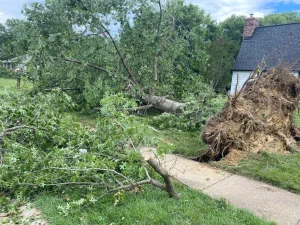
BGE just filled the city in on how they handled the summer storms that knocked out power for a ton of folks, including over 19,000 in Bowie. They’re working on improving their repair times and communication after realizing their estimates were way off due to all the debris and blocked roads.
Here are the highlights:
- BGE briefed the city on summer storms that caused power outages for thousands of customers.
- Nearly 150,000 customers lost power in July, including 19,000 in Bowie.
- 1,230 surplus crews were deployed to assist with repairs.
- Main challenges included blocked roads and debris hindering repairs.
- BGE prioritizes restoration for medical and emergency facilities first.
- Crews use smart meters and patrols to assess outages and perform repairs.
- Average outage duration was 14 hours in Bowie, compared to 17 hours system-wide.
- BGE has a four-year vegetation management cycle for tree trimming and clearance.
- Improvements are needed in coordination with local emergency management for clearing blocked streets.
- BGE is deploying drones to support repair operations.
- Inaccurate estimated times of repair affected customer planning during outages.
- BGE is updating their outage management system to improve future accuracy and communication.
Stay informed
Sign up for my newsletter and join more than 3,500 of your Bowie neighbors getting regular updates directly from Mayor Mike.
BGE Debriefs City on Summer Storms
A representative from BGE briefed the city Monday on the summer storms that left thousands of customers without power for days.
Dave Wright of BGE described nearly 150,000 customers losing power system-wide in July, including some 19,000 Bowie customers. 1,230 surplus crews were deployed from across the region through mutual assistance agreements with sister utilities to tackle repairs.
The main challenges facing crews were the unusual number of blocked roads and the density of debris inhibiting house-to-house repairs. These resulted in hours of labor intensive clean up in addition to normal restoration work.
BGE described their response procedures in detail. Medical and emergency facilities receive priority restoration services first. From there, crews target repairs in clusters, focusing on the largest groups of customers first, working their way down to the smallest clusters, and eventually going to individual homes.
Crews rely on real time knowledge of outages through smart meters and deploy patrols wearing voltage detecting vests to take readings street to street. Overhead crews then walk back lines to points of origin to make upstream repairs.
BGE crews cut and clear as quickly as possible to get customers restored fast—only the most essential work is performed during significant storms. Subsequent return work is performed once power is restored, often when customers notify BGE of a specific need.
Overall, average Bowie outages this summer lasted 14 hours compared to systemwide outages, which averaged 17 hours.
BGE also discussed its four-year vegetation management cycle, established by the Maryland Public Service Commission. This is the program of tree trimming and vegetation clearance in which crews cut back vegetation to the degree it would take to regrow within a four-year cycle.
BGE continues to study the summer storms to identify areas of improvement. It has acknowledged a need to better coordinate with local emergency management offices to more quickly identify and clear blocked streets. BGE is also starting to deploy drones to support their repair operations.
A major challenge for customers this summer was estimated times of repair, which were often highly inaccurate, resulting in residents being unable to plan for refrigeration, device charging, and travel. BGE described their automated repair time estimates as a function of an outage management system designed to calculate repair times based on the number of outages, number of crews working, and dispatch times.
They described their system as normally highly accurate, but the size of the summer storms and the sheer amount of excess debris contributed to significantly more clearance work house-to-house and threw off repair times significantly.
BGE is still working on updating their system based on their experience with these storms to improve future accuracy and communication.
The full presentation can be viewed at the city’s Youtube page, here at 33:35.
The image is from a WTOP article on a summer tornado that touched down in Bowie. Read the full article here.