
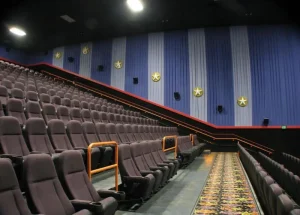
Regal Cinemas is shutting down 39 theaters, including the one in Bowie, and local officials are looking for new entertainment options for the area. There’s a lot of talk about balancing development with community needs, especially after some controversial projects in the past.
Here are the highlights:
- Regal Cinema’s parent company filed for bankruptcy, resulting in 39 theater closures including locations in Bowie, D.C.’s Gallery Place, and Rockville.
- Bowie City Councilmember Michael Estève is exploring new uses for the closed theater site and engaging with entertainment industry representatives.
- The theater industry is experiencing consolidation due to competition from at-home streaming and the pandemic’s impact.
- The city aims to ensure any new development is economically viable and beneficial to the community.
- Maryland and Virginia grant land use authority to county governments, complicating local development efforts.
- Recent resident frustrations over growth and development proposals have led to political backlash, including a historic recall of a councilmember.
- City plans call for higher density and mixed-use communities, particularly around major road intersections.
- Trust in the development process is low among residents, exacerbated by concerns over traffic and school conditions.
- Successful redevelopment efforts require community engagement and fair processes.
- Any new plans for the Regal site will involve extensive review and public stakeholder meetings.
Stay informed
Sign up for my newsletter and join more than 3,500 of your Bowie neighbors getting regular updates directly from Mayor Mike.
Regal Bankruptcy Closes Area Theaters
Regal Cinema’s parent company filed for bankruptcy and announced 39 theater closures, including its Bowie location.
D.C.’s Gallery Place and Rockville theaters are also being shuttered. These follow another 11 previous Regal closings.
Bowie City Councilmember Michael Estève has been working with city economic development and planning staff to explore new users. The councilmember has been in touch with entertainment industry representatives to see whether a new theater or entertainment venue is feasible.
“The main thing we’re hearing from the theater industry is ‘consolidation’,” the councilmember stated. “Theater attendance was already facing stiff competition with at-home streaming, and then the pandemic brought the industry to a standstill.”
The theater and attached parking lot are owned by Knoxville-based Regal Entertainment Group. The city has reached out to the company to learn more about their plans for the property moving forward.
“Whatever happens with that parcel, we want to be sure it’s economically viable, creates value-add for the corridor, and serves as a destination for residents as the theater once did,” the councilmember added.
Economic development has been a long contentious issue in the city, which principally has review and recommendation authority over what gets built in and immediately around its border.
Maryland and Virginia maintain a tradition of giving county governments land use authority rather than municipalities. The only regional exemption is Laurel, MD, which is divided between several county jurisdictions.
Residential and commercial growth allowed the city to build a city gym and senior center, manage a large portfolio of parks and ball fields, and create its own police department without raising city property tax rates for fourteen years.
In recent years, however, resident frustration with new growth, especially along the 301 corridor, and development proposals that would reduce forest and green space, have generated political blowback.
A proposal to include 400 apartment units as a part of the redevelopment of the previously blighted Marketplace shopping center resulted in a historic recall of a sitting city councilmember who supported the project.
That housing proposal ultimately failed and the land currently sits vacant as surplus parking adjacent to the redeveloped center.
Most recently, city officials have begun hearing more resident interest in new and better retail and restaurant options, which business owners frequently state is less feasible without more dense, mixed use communities.
City economic development plans currently call for higher density and mixed use communities at the city’s center around 301, 50, and 197, with less density outside of that center.
Major projects South Lake and Mill Branch stood out as exceptions to that strategy, both high-density housing and commercial projects on 301 that enjoyed strong county backing and benefited from city and county tax breaks.
“There are places in the city where density and mixed use make sense and would have less of a traffic impact,” stated Councilmember Estève, “But resident trust in the development process is very low.”
“South Lake will not generate a cent in positive city revenue for thirty years. Mill Branch got a last-minute county tax break,” the councilmember explained. Estève and his District 2 council colleague Dufour Woolfley opposed both projects which included steep tax discounts and zoning changes.
“If schools and roads improved alongside growth, resident opposition to development wouldn’t be so strong. The problem is roads and schools are getting worse, and arbitrary zoning changes and developer tax breaks harm public trust. Residents get a sense the process is rigged.”
The councilmember described that rebuilding that trust is essential to supporting balanced growth going forward.
“When the Sears property owner approached the city with a plan to redevelop the site with a mix of commercial and residential, we were able to get unanimous support,” said the councilmember.
“Sears had gone bankrupt and closed. It was in the city’s commercial center, already surrounded by denser housing, and at the intersection of all our major road arteries. The property owners didn’t ask for special treatment, zoning changes, or tax giveaways. They had a straightforward plan consistent with long established zoning rules to revitalize an ailing site.”
“And they worked with us to plan for reduced car trips, maximize walking, and think carefully about creating retail space all residents would enjoy,” the councilmember added, “We were able to support that.”
The commercial owner of the Town Center parcel that includes Sears itself faced hard times after the agreement and is currently for sale. The redevelopment proposal is still in the works, but will be contingent on a new owner’s plans.
Should a new owner choose to move forward with those plans, they will be able to redevelop the site with several thousand square feet of commercial retail supported by 600 residential units with redesigned parking, improved road entrances and exits, and safer pedestrian and bike connectivity.
“Residents aren’t inherently pro or anti-development. They just want to know the process is fair, consistent, and will improve the community, not take away from it.”
Any new plans for the Regal site would take years of review and permitting, a process of public stakeholder meetings, Bowie Planning Advisory Board, City Council, and Prince George's District Council hearings.
"Whatever comes of this, we want to make sure the public is engaged and the result serves the community," Councilmember Estève concluded.