
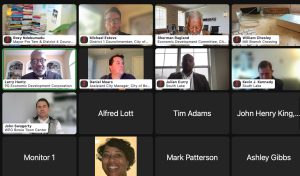
City officials and local business leaders just had a virtual chat about the tough times small and upscale shops are facing, like attracting customers and dealing with slow permit processes. They’re all on the same page about needing to work together to improve the local retail scene and make Bowie a more appealing place for businesses.
Here are the highlights:
- City officials and business leaders discussed challenges in attracting and retaining small and high-end restaurants and stores.
- Marketing and tenant selection are key issues for shopping center owners.
- Walkable communities are preferred by business and residential tenants.
- Bowie’s aging population poses challenges for attracting younger customers.
- Retailers are increasingly drawn to areas with high population density and disposable income.
- Red tape and slow permitting processes hinder business development in Prince George’s County.
- Infrastructure costs are impacting housing and business rents, making them less affordable.
- Collaboration between city officials and the business community is essential for economic development.
- Future policies will shape the city’s retail landscape and attract high-end businesses.
Stay informed
Sign up for my newsletter and join more than 3,500 of your Bowie neighbors getting regular updates directly from Mayor Mike.
City, Business Leaders Discuss Retail Challenges
City officials and area business leaders convened virtually Saturday to discuss challenges in attracting and retaining small, independent, and high end restaurants and stores.
The gathering was hosted by the City of Bowie and led by local real estate magnate, Sherman Ragland. It was part collaboration and problem-solving, part airing concerns between city and county officials and members of the local retail, commercial, and development sectors.
Among the business participants were local developer Kevin Kennedy, of NAI Michaels, the company behind the South Lake development project on 2014 and 301, and Bill Chesley, behind the ongoing Mill Branch development on 301. Also attending from the business community were representatives of the Bowie Town Center.
Opening the discussion were questions of how shopping center owners market their businesses and choose tenants. Kennedy stated that marketing was a straightforward process. He emphasized the real challenge is striking a balance between attracting a mix of national retailers while nurturing local entrepreneurs within the community.
Chesley agreed, noting that while marketing wasn't a significant problem for his company, finding the right blend of retailers has been key to ensuring businesses co-exist and survive longterm in the same shopping centers.
Chesley also emphasized the trend of business and residential tenants preferring walkable communities. Good development, according to Chesley, will incorporate ample amenities within a community to reduce car trips and provide regular foot traffic to onsite businesses.
One notable point of discussion was the city's appeal as an affluent, well-educated community. Larry Hentz of the Prince George's Economic Development Corporation (EDC) shared that while Bowie is a regional leader in affluence and education, it is an aging community, with a large share of its population over the age of 55.
This, he observed, can be a challenge as retailers often look for communities with a greater blend of customers, especially young professionals with disposable income, a demographic Bowie lacks.
John Swagerty, representing the Bowie Town Center, agreed, and shared that while sit-down restaurants and fast-casual eateries had been excellent performers at the center, online shopping had led many retailers to operate with fewer physical stores and prioritize locations with a stronger customer base.
Prince George's County Councilmember Ingrid Watson inquired specifically about the loss of Bowie Town Center shopping to nearby Waugh Chapel. Swagerty attributed this trend to newer centers in Gambrills and Crofton offering better visibility and more front-of-store parking, aligning with changing retail trends.
Ragland pointed to the size and foot traffic advantage of Waugh Chapel, three times that of the Bowie Town Center, with higher housing density on-site. Swagerty added that many retailers seek shopping centers with a minimum of one million square feet and a diverse store mix, aiming to be regional draws.
Several questions were raised about how retailers decide where to do business. Sherman Ragland pointed out that major retailers are sophisticated decision-makers, focusing on highly populated areas with significant disposable income. Major stores operate with extensive customer data, with a high level of certainty of where they can and can't succeed.
City officials chimed in inquiring about the disconnect between residents' desire for higher-end stores and the retailers the city has lost. All of the business representatives agreed that retailers today seek dense population centers, noting the successes of College Park and Hyattsville in attracting high-end apartments to their corridors to draw elite restaurants and stores.
Ragland stated his own Bowie neighbors often express a desire for Wisconsin Avenue shopping without Wisconsin Avenue housing, noting that DC residents once considered a high end downtown commercial center laughable. Several policy changes, sometimes unpopular, brought the wealth and housing density that have made DC a draw for name-brand retailers, something Bowie could emulate.
Red tape was a major topic of conversation, with several of the business representatives underscoring the need to address the challenges posed by Prince George's County's notoriously slow and unpredictable permitting process.
Swagerty and Kennedy advocated for the city to provide support to businesses navigating county permitting, potentially by hiring a permit expediter or simply having a dedicated point of contact in the city to assist businesses struggling through red tape.
Representatives for the Prince George's County Department of Permitting, Inspections, and Enforcement (DPIE) noted their agency has made improvements, moving applications to an entirely online portal, and hiring staff to guide applicants through the process in pre-application meetings.
Larry Hentz echoed that DPIE had personnel to assist businesses through the permit process, and encouraged better communication with retailers, brokers, and developers. Hentz noted that other jurisdictions faced similar permit-related challenges.
Councilman Estève noted that in conversations with local contractors and business owners, Prince George's is consistently cited as one of the most challenging jurisdictions for permits, indicating something is clearly broken. DPIE stated they believe many applicants aren't aware of the resources available to them through their agency, something they can address with better communication.
Ragland agreed that policy changes at the county level could help streamline permitting, noting that Prince George's wealth was increasingly moving to other counties where businesses have an easier time navigating local rules.
Ragland noted that neighboring Charles County has officially displaced Prince George's as the wealthiest minority-majority county in the country, adding that wealthy families of color were drawing high end retailers out of Prince George's.
Another question was raised about the challenge of shoplifting as a potential business deterrent. Councilmember Watson observed that retail theft is long-rumored to be a challenge in retaining local businesses.
Bowie Town Center representatives stated that theft in Bowie is not as severe when compared to other shopping centers they own, and they did not believe it was sufficiently bad to dissuade tenants from coming to Bowie.
Zina Redfearn, with the Bowie Town Center, praised their partnership with the Bowie Police Department and suggested that increased police presence would help further deter what retail theft exists.
Participants then discussed the impact of infrastructure costs on business and housing rents. Chesley noted that states, counties, and cities once bore the costs of public infrastructure, observing that developers increasingly pay those expenses, which are then passed on to tenants.
Chesley and Kennedy stated that this had an impact on housing costs, stating that single family homes and even townhomes were increasingly hard to build at rates affordable to most families. It also impacts rents payed by business tenants and can be especially burdensome to small and independent entrepreneurs.
They added the need for greater flexibility in zoning and permitting to accommodate the evolving retail landscape. Government rules are simply not changing fast enough to accommodate changes in customer preferences, according to the builders.
The meeting ended on a collaborative note, with participants agreeing to follow up on these concerns and work together to foster a strong local business environment.
While some details discussed at the meeting were new, many of these topics have come up before. City economic development staff have many times raised the issues of county permitting and housing density as a challenge for attracting restaurants and retailers.
These issues were also discussed in meetings with the council and the city's volunteer Economic Development Committee, visiting expert brokers, and at the many review stages of proposed development projects.
These topics also came up during the process of drafting and presenting the city's consultant-created economic development strategy in 2022.
Moving forward, it will be critical the city foster a productive working relationship with the new Prince George's County Council, which controls land use, a great deal of business regulation, and zoning, all related to the concerns raised at the meeting.
Should the city choose to adopt the recommendations from this and past economic development discussions, it will need to work closely with the county and business community to attract development that could spur the denser high-end housing that would draw greater retail and restaurant choices to the city.
While none of these changes could happen overnight, the policies and economic strategy the city adopts now will go a long way in shaping the city's future in the coming decades.
View the full roundtable discussion here.