The Bowie City Council just approved a last-minute $15 million tax break for the Mill Branch development, which has locals upset about losing green space for fast food spots and discount stores. Some council members questioned if they got a good deal, especially since the area is already facing budget shortfalls.
Here are the highlights:
- The Bowie City Council endorsed a county-funded tax deal for the Mill Branch Crossing development.
- The tax relief request was added to the agenda last-minute with no supporting documents.
- The project owner is a longtime developer and major political contributor.
- The tax deal involves $15 million in tax relief funded by Prince George’s County.
- This follows a similar controversial tax subsidy for the South Lake development in 2019.
- Mill Branch will replace 64 acres of woods with commercial retail, a hotel, and over 500 residential units.
- Commercial tenants signed include Chipotle, Dash-In Convenience, Discount Tire, and Popeyes.
- The project has faced criticism from residents regarding the loss of rural space and the nature of the retail tenants.
- Councilmembers Woolfley and Estève voted against the tax deal.
- Improvements to the surrounding area are underway but are not expected to alleviate traffic flow issues.
- Officials claim the project will maintain regional Green Branch Park and include a goal for 10% workforce housing.
- The development is expected to be completed by 2025.
Stay informed
Sign up for my newsletter and join more than 3,500 of your Bowie neighbors getting regular updates directly from Mayor Mike.
City Approves Last Minute Tax Break for Mill Branch Development
The Mill Branch Crossing development underway at 301 received the Bowie City Council's endorsement for a county-funded tax deal on Monday.
A request for a letter of support for a county Tax Increment Financing deal was added to the city's agenda last-minute with no supporting documents.
The project's owner is a longtime area developer and major campaign contributor who has given generously to support area political candidates and elected leaders.
On Monday, a lawyer for the developer attended the city council meeting to request the city's endorsement of $15 million dollars in tax relief, to be funded by Prince George's County. The tax benefits would subsidize infrastructure costs for which the developer would otherwise be responsible.
This follows a similar pattern in which the South Lake development at 301 and 214 controversially received a major subsidy in the form of Tax Increment Financing in 2019.
That project, also supported by the past and current Bowie City Council, involved a deal in which the city and county agreed to subsidize the private project's infrastructure costs to the tune of $30 million.
In the TIF arrangement, the infrastructure costs are paid back from future tax revenue that would otherwise fund public services.
All but two councilmembers backed the tax deal, with Councilmembers Woolfley and Estève alone in voting no.
The Mill Branch project, originally a strictly commercial concept, converted to a mixed use development with the support of the previous Bowie City Council in 2019. The development received subsequent approvals from a majority of the current council in 2021 and 2022.
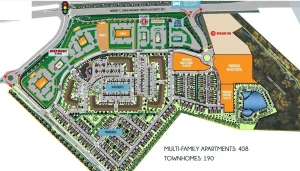
The new development replaces 64 acres of woods and rural tier space with 77,000 square feet of commercial retail, a 150-room hotel, and over 500 apartment and townhomes.
So far, Mill Branch has signed commercial tenants Chipotle, Dash-In Convenience, Discount Tire, and Popeyes.
The Mill Branch project, currently the site of major forest clearing, also obtained a last minute letter of support from the Bowie City Council for a separate tax break earlier this year.
That deal involved county tax forgiveness for which the project previously did not qualify. Outgoing county officials sought to make an exemption for Mill Branch, which was approved following the city's support.
Mill Branch's representatives lined up several area business owners with previous affiliations with the developer to speak in support of Monday's request for support.
The developer described that unlike the South Lake deal, this tax break would not involve the issuance of bonds. It would still be funded by new county tax revenue generated from the project—revenue that would otherwise support the costs of the public services benefiting the development.
Prince George's County currently faces growing budget shortfalls as it struggles to keep up with school and public safety funding in spite of significant new growth.
"The main benefits of development are improved retail and new tax revenue," Councilmember Estève stated. "In this case, we're accepting Class C retail and giving tax revenue away."
"$15 million is a lot of money for fast food and discount tires," said one resident who attended the meeting. "I'm not sure the council got the best deal here."
Councilmembers inquired about whether the tax relief would support improvements to 301. The developer answered it would focusing on improving intersections immediately around the new development.
Improvements to 301 are underway and funded by Maryland State Highway. These improvements are not expected to smooth traffic flow and are focused instead on upgrading traffic barriers, adjusting pavement markings, and improving drainage systems.
An announcement of the confirmed retail tenants last week was met with frustration by area residents even before the tax deal was proposed.
"I'm disappointed the county's remaining rural tier is being destroyed for tenants like Chipotle and Popeyes," one resident wrote.
Residents in nearby Mill Branch and Collington Station have spoken unfavorably of the new development along the 301 corridor in numerous past meetings and forums.
Area development, driven by strong regional demand for new housing, is in many ways inevitable, and tax deals are increasingly common tools for local governments to attract choice retailers and extract concessions.
In the case of Mill Branch, officials have touted the maintenance of the regional Green Branch Park and the inclusion of a "goal" for 10% workforce housing, a compromise from an original demand for guaranteed affordable housing at the site.
"I get a deal for a high-end grocer or something. But that's not what we're getting here," wrote another resident.
The project, which started under a 2006 county map amendment, is expected to be completed in 2025.
View the council discussion and vote at 1:55 here. Supporting documents related to the project can be found here.