
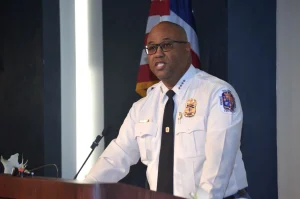
There was a meeting at Bowie State University where residents and local leaders talked about the rise in juvenile crime and shared ideas for solutions, like new laws and community programs to help keep kids out of trouble. It’s clear everyone wants to tackle this issue seriously and make schools safer.
Here are the highlights:
- Residents and local officials gathered to discuss rising juvenile crime at Bowie State University.
- State Senator Ron Watson emphasized the need for appropriate consequences for serious youth crimes.
- Recent trends include a violent carjacking spree involving minors and incidents of guns on school campuses.
- Bowie High School Student Government President Lydia Murphy highlighted student concerns about safety and the need for early intervention.
- Prince George’s County Chief of Police Malik Aziz noted challenges in addressing juvenile crime due to recent legal changes.
- State’s Attorney Aisha Braveboy stressed the importance of education and parental accountability in combating juvenile crime.
- Millard House, the new schools superintendent, pointed out the link between truancy and juvenile crime.
- Senator Watson proposed several bills aimed at curbing youth crime, including diversion programs and enhanced penalties for organized theft.
- Community members expressed satisfaction with local leaders’ commitment to addressing youth crime.
Stay informed
Sign up for my newsletter and join more than 3,500 of your Bowie neighbors getting regular updates directly from Mayor Mike.
Residents Discuss Solutions to Juvenile Crime
Residents and local officials gathered at Bowie State University Tuesday night to discuss rising juvenile crime and potential legislative solutions.
Hosted by Prince George's County Council Member Ingrid Watson, the discussion featured talks by state and county elected leaders, and numerous county law enforcement officials.
State Senator Ron Watson opened the forum, detailing a series of high-profile area crimes involving youth. The Senator stated the goal was, "Setting a standard of expectations. We are not going back to mass incarceration, but big boy crimes deserve big boy punishments."
Among the alarming trends, Sen. Watson described a violent regional carjacking spree involving three 15 year olds and an 18 year old from Virginia. The Senator also cited incidents of teenagers bringing guns to high school campuses and described a music teacher attacked at an elementary school.
Among guest presenters was Bowie High School Student Government President Lydia Murphy, who described that local students are tired of never-ending safety concerns.
Murphy thanked Bowie Police for acting quickly to disarm a teenager this month who attempted to bring a loaded ghost gun to campus.
Murphy shared survey feedback from Bowie High students, noting that over half believe crime has gotten worse. She stated that students supported a mix of greater mediation and stronger disciplinary action to address campus safety.
She also shared that students felt more intervention was needed earlier at the middle school level, along with more consistent enforcement of rules, and greater parental involvement starting at home.
She also noted that many students worried about a slippery slope of endless security measures making the school feel more like a prison.
Prince George's County Chief of Police Malik Aziz spoke next, stating that while young people understand right from wrong, some are struggling to fully appreciate the consequences of their behavior.
The Chief noted that while homicides are down from last year, robberies, carjackings, and assaults are up, with violent carjackings becoming a principle focus of county law enforcement.
Aziz stated that gun confiscations and arrests are down from past years following a change in marijuana laws making it harder to search vehicles based on the smell of cannabis.
The Chief also observed that changes to Maryland law preventing police from speaking to juvenile suspects without an attorney present made solving juvenile crime considerably more difficult.
Attorneys rarely allow their clients to interact with law enforcement when they are potentially suspected of a crime. The law means police are unable to engage in much of the early fact-finding necessary to complete investigations.
"We're not trying to repeat mass incarceration. But police need more avenues to interact positively with kids," Aziz stated.
Aziz closed by noting that recidivism studies show the juvenile justice system tends to send young people who commit serious crimes back to dysfunctional homes, propelling a vicious cycle.
"We have many good kids doing great things. But we need to figure out what to do with a small number of hardcore criminals."
State's Attorney Aisha Braveboy spoke next, opening that education is the most powerful weapon in the fight against juvenile crime.
Stating that crime was in decline through 2018, big spikes were observed during the pandemic, driven in part by young people who were not in school.
Braveboy stated that to this day, "Many of our kids committing crime have spotty school attendance records or are not attending at all."
She added, "We need to work with our young people and their parents. That's one area where we can hold parents accountable, though truancy."
Braveboy detailed how juveniles are automatically charged as adults for numerous violent crimes. "Many of these young people think they're invincible and are often surprised, and their parents are surprised, when the law comes down on them," she said.
She stated that carjackings do not fall in the category of automatic adult charges, and judges often refer these cases to juvenile court.
She also observed that recent state laws have made seizing illegal firearms much more difficult. "Guns have unfortunately become popular among young people."
In the past, the county seized 40 to 45 illegal guns per month. Since new state laws have gone into effect, illegal gun confiscations in the county are down to 16 per month, though the number of illegal firearms in people's possession has likely only increased.
Millard House, the recently appointed Prince George's County Schools Superintendent, echoed the State's Attorney's observation that most juvenile crime is committed by students who are repeatedly truant.
"A lot of our students don't have that role model and support system at home," said House. "Chronic absenteeism is a major crisis."
For safety within schools, House stated, "Investing in the latest technologies is crucial. Our schools must be prepared for the worst case scenarios."
House also suggested mandating safe firearm storage at home, increased funding for wrap-around mental health support, and improving school building security.
State Sen. Watson returned to the podium to discuss a series of bills he is sponsoring in the upcoming Maryland General Assembly session aimed at curbing youth crime.
He described the legislation was prepared in consultation with the offices of the U.S. State's Attorney and Prince George's County State's Attorney, county and city law enforcement, the school superintendent, and local NAACP chapters.
One bill would expand a diversionary program through the Maryland National Guard to help instill student discipline and aid truant youth in completing their GEDs. The program is an alternative to juvenile services which often does little to break the cycle of student recidivism.
Another bill targets organized retail theft. The Senator stated that organized groups know that felony theft charges begin at $1500 in stolen items. Watson described, "Kids are literally coming into stores with calculators adding up how much they're stealing."
The bill would aggregate the value of all stolen items across stores and jurisdictions, applying felony charges to every individual involved in organized theft incidents. The bill would also factor in the cost of damage in smash and grabs.
Another bill would aim to deter gas station carjackings. The Senator stated the bill would require gas stations in Prince George's County maintain security cameras and have an attendant onsite available to pump gas from 6am to midnight.
Other bills would set up studies of AI and video technology to detect firearms in restricted spaces, as well as require ballistic slug tests for new and sold firearms to help trace guns involved in crime.
Other bills would stiffens penalties for the distribution of Fentanyl and reform juvenile services, making it easier for social services to intervene in the case youth offenses with firearms.
The Senator touted that each of these bills already has co-sponsors, including support from across the aisle. "I want to get rid of the notion that this is about Democrats and Republicans. I am agnostic about where good ideas are generated."
Attendees stated they were pleased local leaders are taking the issue of youth crime seriously. "It's been a long time coming," stated a Bowie resident who attended the forum. "Our leaders showed us tonight they're listening and they're actually doing something."
Residents can view the forum presentations here.